Something in the Room / NO. 002
Something in the Room is our October Halloween series on rock mythology and haunted film sets: the legends, the people who tell them, and the work that goes on amid the scares.
In 1973, Black Sabbath went to Clearwell Castle hoping to break a writing block. They found a new album, a disappearing visitor and plenty of reasons not to trust their bandmates after dark.
By Margin Tone
By 1973, Black Sabbath had helped give heavy metal its sound: immense guitar riffs, ominous songs and a force that set them apart from the blues bands they had grown out of. Four albums, including Paranoid and Master of Reality, had made the Birmingham musicians famous. Guitarist Tony Iommi, singer Ozzy Osbourne, bassist and principal lyricist Geezer Butler, and drummer Bill Ward now needed a fifth. They went to Clearwell Castle in Gloucestershire to write it.
Then Iommi found himself looking under a table. He and Ozzy had followed a figure into the armoury, and now they couldn’t find anyone. In Iommi’s account published by Classic Rock in 2019, the room had one door and no windows. Somebody had gone in. Nobody had come out. They searched for a hiding place, including beneath the furniture, in case someone was playing a joke.
It is a wonderfully undignified detail to survive in the memory of a heavy-metal pioneer. Before accepting that he had encountered the supernatural, he checked for somebody crouching under a table. He knew the people he was staying with.
Iommi remembered the early reviews hurting, and listeners assuming the musicians were involved in black magic. An inverted cross inside their first album’s sleeve had helped establish that impression; he said the band had nothing to do with putting it there. “We were young, totally green, and we took it personally,” he recalled.
By the time they needed the new record, Iommi was struggling with something he hadn’t encountered before. He could no longer produce ideas he wanted to use. The band had gone back to Los Angeles, where they had made Vol. 4, but the return accomplished little. A booked studio and familiar surroundings couldn’t make the next song arrive. They abandoned the attempt and went home to England.
“The more worried I got, the worse it got,” he told Classic Rock in a 2011 interview. Getting everyone away from interruptions, into a place with a different atmosphere, offered something practical to try.
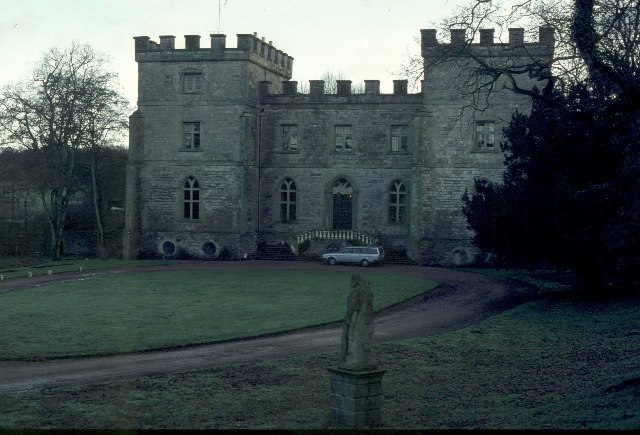
Clearwell looked much older than it was. Its towers and battlements belonged to an eighteenth-century country house, rebuilt for Thomas Wyndham in 1727. It had survived a fire in 1929 and a period of ruin before the Yeates family began restoring it in the 1950s.
The band carried its equipment into the basement rooms they called the dungeons. This was somewhere to write and rehearse; Sabbath Bloody Sabbath would subsequently be recorded at Morgan Studios in London.
Iommi has described the vanished visitor more than once, with details shifting between tellings. In his 2009 Guitarist account, he couldn’t remember whether Ozzy or Geezer had been beside him. What remained clear to him was a cloaked figure approaching along a hallway, entering a room and disappearing. When they told the people who owned the castle, he said, the response was casual: they already knew about its ghost. Their hosts apparently thought there was nothing unusual to explain.
Ozzy was quite capable of supplying disturbances of his own. In an excerpt attributed to his memoir I Am Ozzy, he described hiding an eight-track player under Iommi’s bed after an evening’s séance. The volume was turned down, but the mechanism would still make its sudden clunk, echoing off the stone walls. He had found a way to frighten his guitarist with a music machine that wasn’t playing any audible music.
Ward was another target. In the prank recounted by Rolling Stone, Butler, Iommi and Ozzy held a full-length mirror close to his sleeping face, then prodded him awake. His own reflection supplied the apparition. These were elaborate preparations for an exceptionally mean few seconds.
Iommi acknowledged the cruelty of the band’s humour when he looked back. Asked about setting Ward’s beard on fire, he said: “It’s pretty sad, really, isn’t it?” The mirror was one part of a much less endearing habit of making the drummer the victim.
The music did come. Iommi remembered the riff for “Sabbath Bloody Sabbath” arriving as soon as they began working downstairs. He liked its sound, and they built from there. The first usable song gave them a direction for the others. In telling the story, he credited the atmosphere of the castle.
Butler remembered the breakthrough in an excerpt from his memoir Into the Void. Iommi announced, “Well, I’ve got one thing,” before playing the riff. “Relief washed over me,” Butler recalled, because it meant they had “a present and a future.” Years later, he was still indignant on Iommi’s behalf about lists of great guitarists that placed him too low. He had spent almost fifty years beside the man, hearing ideas arrive. This was one of the times he had most needed to hear another.
The title song gave Butler somewhere to put frustrations that were thoroughly familiar. He said its lyrics concerned the band’s own experience: success, disappointments, exploitation and the people surrounding their business. Its anger had identifiable recipients, including management, accountants and critics. Coming out of the castle, Sabbath had a song about what it felt like to be Black Sabbath.
At Morgan Studios, the record grew beyond the four musicians. Rick Wakeman was working there with Yes, and Ozzy asked him to contribute keyboards. Wakeman recalled arriving after his own session, around midnight, to find the Sabbath musicians sprawled out, overwhelmed by drink. A nervous tape operator had been left to get him started. Ozzy had apparently assured the young man that Rick would know what to play.
Rick didn’t. He listened to the track a couple of times, worked out a part and recorded it, prepared to return if they didn’t like what he’d done. In his telling, Ozzy briefly roused himself to deliver an enthusiastic verdict, then subsided again. The contribution was to “Sabbra Cadabra.”
The closing track, “Spiral Architect,” brought in strings credited to the Phantom Fiddlers, arranged by the band and Will Malone and conducted by Malone. The record that had seemed beyond them now had room for guests.
For all the music they found there, Clearwell had defeated their sleeping arrangements. In the account attributed to Iommi’s memoir Iron Man, Geezer initially wanted to stay in a supposedly haunted room and experience its atmosphere. Eventually, nobody could be sure whether a disturbance belonged to the building or to a bandmate. They had rented somewhere remote so they could concentrate on writing together. They frightened each other so badly that they began driving home at night. The next day, they drove back.


