Before the books could pay her bills, Butler had to learn how to send out a story, find useful readers and keep working through long stretches without a sale.
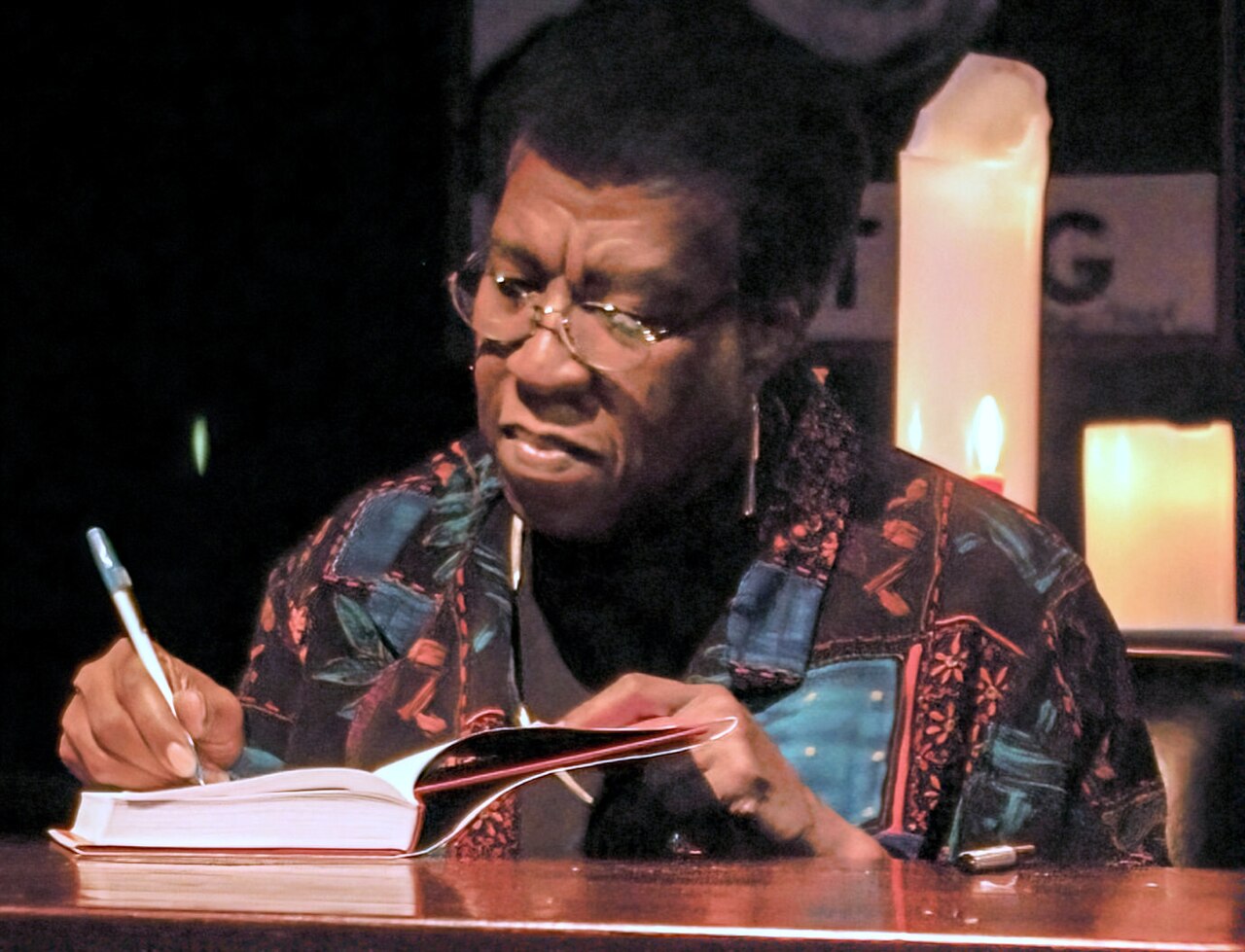
By Margin Tone
Octavia E. Butler (1947–2006) was a Black American science-fiction writer who put Black women at the centre of stories about power and survival. In Kindred (1979), a Black woman from 1970s California is pulled back into the world of her enslaved ancestors. In Parable of the Sower (1993), a young woman tries to build a community as climate disaster and inequality tear California apart. Butler used imagined worlds to make questions about freedom, dependence and responsibility painfully concrete.
Her work won science fiction’s leading prizes: Hugo Awards for “Speech Sounds” in 1984 and “Bloodchild” in 1985, and two Nebula Awards. In 1995 she received a MacArthur Fellowship, becoming the first science-fiction writer to do so. That recognition came after an apprenticeship stretching from a Pasadena childhood in the 1950s through years of classes, day jobs and rejected manuscripts. Her mother helped pay for it long before a publisher did.
Butler began writing stories at ten, in the late 1950s. Her mother bought her a Remington portable, despite a friend’s warning that it would soon be gathering dust in a closet. Butler already wanted to sell a story. She pecked at the typewriter with two fingers. Eventually she asked her science teacher, Mr. Pfaff, to type a story properly, without the strike-overs and holes she had erased into the paper. He corrected her spelling and punctuation, too. Years later, she was still grateful.
She remembered that help in “Positive Obsession,” an autobiographical essay first published in 1989. She had stories to tell and a formidable appetite for books. Getting her work from a notebook into an editor’s hands was another matter. The library books she tried weren’t much use until she found a discarded copy of The Writer. That sent her back to the library looking for more writers’ magazines. She learned how to submit a story, posted one and received a rejection.
Her mother’s employers supplied another, less orderly library. A domestic worker who had received only three years of schooling, she brought home the books they threw away. Some lacked covers; others had been written in, spilled on or partly burned. She didn’t know which ones her daughter could use, so she collected whatever she found. Butler kept them in crates and second-hand bookcases, growing into books that had initially been beyond her.
Money went into the writing as well. Early on, a supposed agent charged her mother $61.20 to read a story. That was more than a month’s rent. Neither of them knew that an agent should be paid from a sale rather than charge them upfront. Butler’s recollection is blunt: “Ignorance is expensive.”
During the 1960s, school offered readers, though not always the readers she needed. Teachers could be encouraging without explaining how to improve a piece. Her college writing teacher eventually asked whether she could write anything “normal,” instead of the science fiction and fantasy she kept handing in. At eighteen, Butler won a college contest judged from anonymous submissions. The prize was $15, her first earnings from writing.
Butler earned an associate degree from Pasadena City College in 1968. The work she took after college paid more regularly than writing: office work, then factory and warehouse jobs, where her height and strength were useful and nobody expected her to smile. In the essay, she recalled getting up at two or three in the morning to write before going to work. She also recalled complaining, quitting and finding another job. After years of collecting rejection slips, she threw them away. They were painful, and she could see no use in keeping them.
In the summer of 1970, at twenty-three, she attended Clarion, a workshop for science-fiction and fantasy writers. There she sold two stories to writers teaching the course. In her account, five years passed without another sale before she sold her first novel. Patternmaster was published in 1976. She had been imagining it since she was twelve, she later told interviewer Joshunda Sanders. The idea belonged to her childhood; learning how to turn it into a publishable novel took much of her young adulthood.
Publication made a small, definite change possible. Butler took her first vacation, buying a Greyhound pass that let her travel around the country for a month. She visited New York and Seattle, then discovered she preferred national parks to cities. In her 2004 conversation with Sanders, she remembered cutting short a Grand Canyon hike when she realised her bus would leave without her.
The novels continued across three decades. After Kindred came books including Wild Seed (1980) and Dawn (1987), the beginning of her trilogy about humans surviving nuclear war with the help—and under the control—of aliens. Parable of the Talents (1998), the sequel to Parable of the Sower, won the Nebula Award for best novel. Her final novel, Fledgling, appeared in 2005, the year before her death.
Through those decades, she remained interested in how writers learned. Classes, she told Sanders in 2004, were a way to “rent an audience”: people could tell you whether you were communicating what you thought you were. Reading widely was part of the work, too. At MIT in 1998, she described keeping four or five unrelated books open around her home, letting their ideas encounter one another. When overwhelmed, she sometimes took a week to read novels and listen to music. The resulting ideas were her excuse, she joked.
Her mother’s work had entered the fiction, too. In the 2004 interview, Butler traced part of Kindred to accompanying her mother to domestic jobs as a small child. She had watched her endure insults and use back doors. Later she told her mother she would never do such a terrible job. Her mother had looked sad and said nothing. As an adult, Butler wanted readers to understand the courage of people whose resistance meant keeping their children fed and getting them further in life. She could name what her mother’s work had provided: she had never gone hungry or homeless, and she had attended college when her mother hadn’t finished elementary school.
In “Positive Obsession,” Butler records another use for the money her books eventually earned. She had paid off the mortgage on her mother’s house. She gives no price for the typewriter, but remembers the wasted reading fee to the cent. Alongside those earlier expenses, she could now put the mortgage she had cleared.


