Mierle Laderman Ukeles brought the work of keeping people alive into art. Following her from home to museum to city means asking why that work is so easily overlooked.
By Margin Tone
When Mierle Laderman Ukeles became a mother, the work of caring for her daughter began to crowd out her work as an artist. Now a baby needed feeding and changing, and the work kept coming back. “I felt like two separate people,” she told NYLON in 2016, “and I wanted to be both.” Much of what she would make began with her refusal to cut either person out of the picture.
Her daughter was born in 1968. The following year, Ukeles wrote her Manifesto for Maintenance Art. Its tasks include changing a baby’s diaper, correcting typos and mending a fence. Then the small troubles start talking: something leaks, somebody doesn’t understand, there are no socks. “Maintenance is a drag; it takes all the fucking time,” she wrote. There’s relief in the impatience. She could insist that this labour mattered without pretending to enjoy every minute of it.
She proposed an exhibition called CARE, taking her everyday work into a museum. She would cook, invite people to eat and clean up afterwards. She even allowed for the institution’s possible reluctance to have her family sleeping there: she could come in every day instead. There would be interviews with other workers about maintenance, freedom and their dreams, and a section treating polluted air, water and land. The work that was filling her days belonged in a museum, she proposed, alongside the work that filled other people’s.
Getting that work into a museum took years. Meanwhile, her days supplied the material. In February 1973, by then the mother of three children, she logged childcare alongside her intermittent attempts to get to her art. On different days she recorded events every hour, half hour or fifteen minutes. The log gave that interrupted time a place in her art.
That year, Lucy Lippard included Ukeles in the travelling exhibition c. 7,500 at the Wadsworth Atheneum in Hartford. The invitation gave her somewhere to test her ideas in public. She arranged four actions, including washing the front steps and the marble floor of Avery Court. Each wash lasted four hours. Her cleaning cloths were diapers, which the museum’s conservators also used.
Inside the museum, though, the value assigned to a task could depend on who performed it. For Transfer: The Maintenance of the Art Object, a maintenance worker cleaned the glass case around an Egyptian mummy. Ukeles cleaned it next and stamped it a “Maintenance Art Original.” Now the case was art, and the next cleaning belonged to a conservator. The person who had been entrusted with the glass before its promotion could no longer do the job. Ukeles had made the hierarchy visible without changing the glass.
In The Keeping of the Keys, she borrowed the guards’ keys and temporarily locked entrances and rooms during opening hours. Notices explained what was happening, and visitors could stay or move elsewhere. The Wadsworth’s retrospective account of the performances records willing participants and annoyed visitors. The museum depended on people who cleaned it and kept it secure. With Ukeles doing their work, that dependence became difficult to ignore.
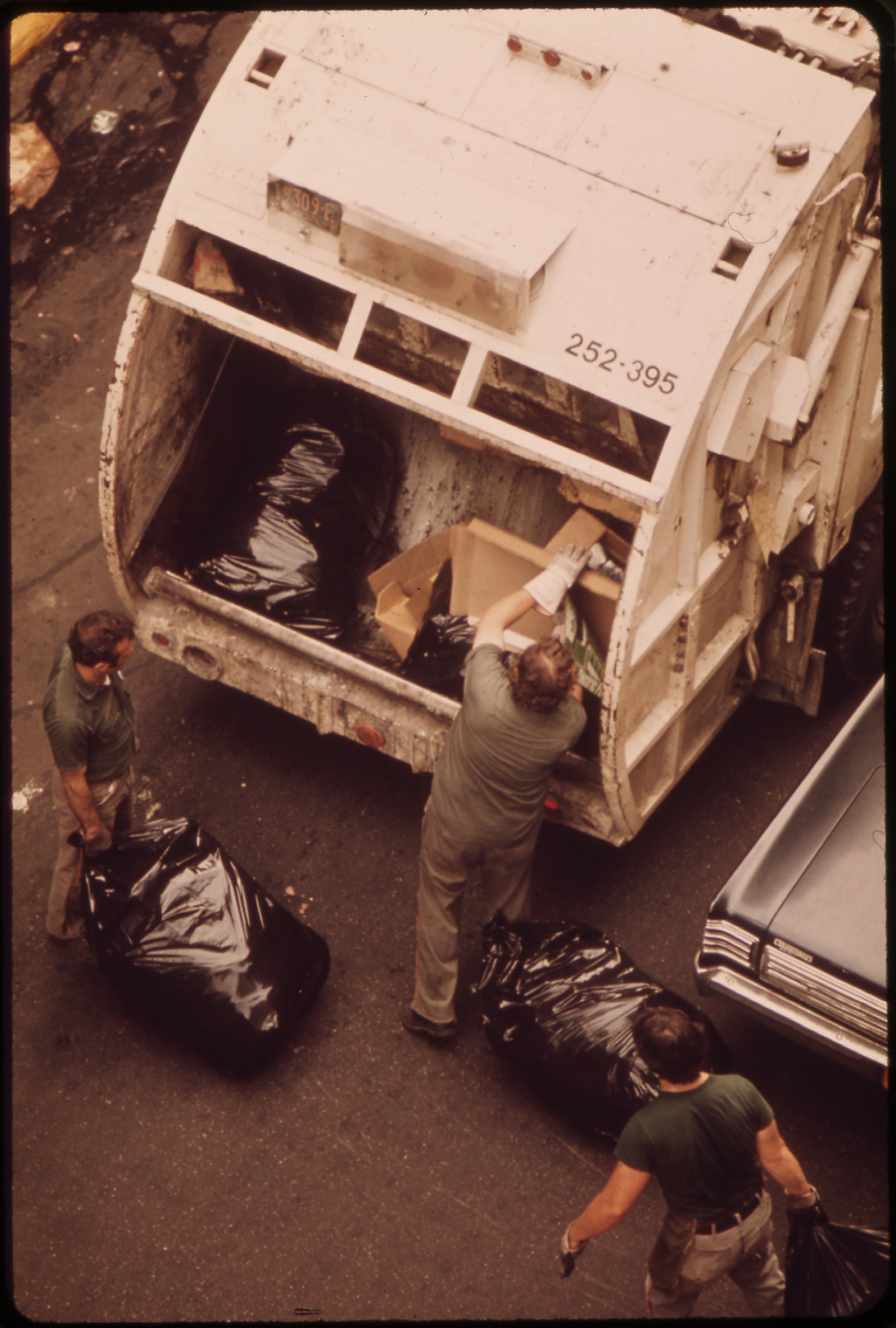
The same question became much larger when she joined New York City’s Department of Sanitation as its official, unsalaried artist-in-residence in 1977. The Wadsworth account traces her next major undertaking to the blizzard of 1978. Workers laboured around the clock to clear the snow and were cheered for getting the city moving. As garbage accumulated and trucks broke down, the cheers gave way to anger. The workers were still out in the freezing weather. Public gratitude had lasted less time than the job.
For Touch Sanitation in 1979–80, Ukeles went to meet them. Eighteen months of research, fundraising and learning the system preceded the eleven-month performance. Across the five boroughs, she visited garages, transfer stations and other sanitation workplaces, shaking hands with 8,500 workers. To each she said, “Thank you for keeping New York City alive!”
The words were simple. Delivering them meant planning routes around waste-collection schedules, travelling with a department driver, working most days and some nights. The artist had to fit herself into the work she wanted acknowledged. Years earlier, her manifesto had asked who would pick up the garbage on Monday morning after the revolution. Now she was making time to thank those people individually, where they worked, before moving on to find the next person.


