Alice Guy-Blaché’s case for women in filmmaking began with work she knew intimately: laboratory study, a carefully prepared set and the patience to direct without shouting.
By Margin Tone
Alice Guy-Blaché ran a film company at a time when women still had to argue that they were capable of directing films. She had begun as a secretary to Léon Gaumont in Paris, learned the work and gone on to lead Solax in the United States. When she wrote about the profession in 1914, she could draw on experience in the laboratory as well as on the set. Her argument for women’s place in filmmaking came with an unusually detailed account of the job.
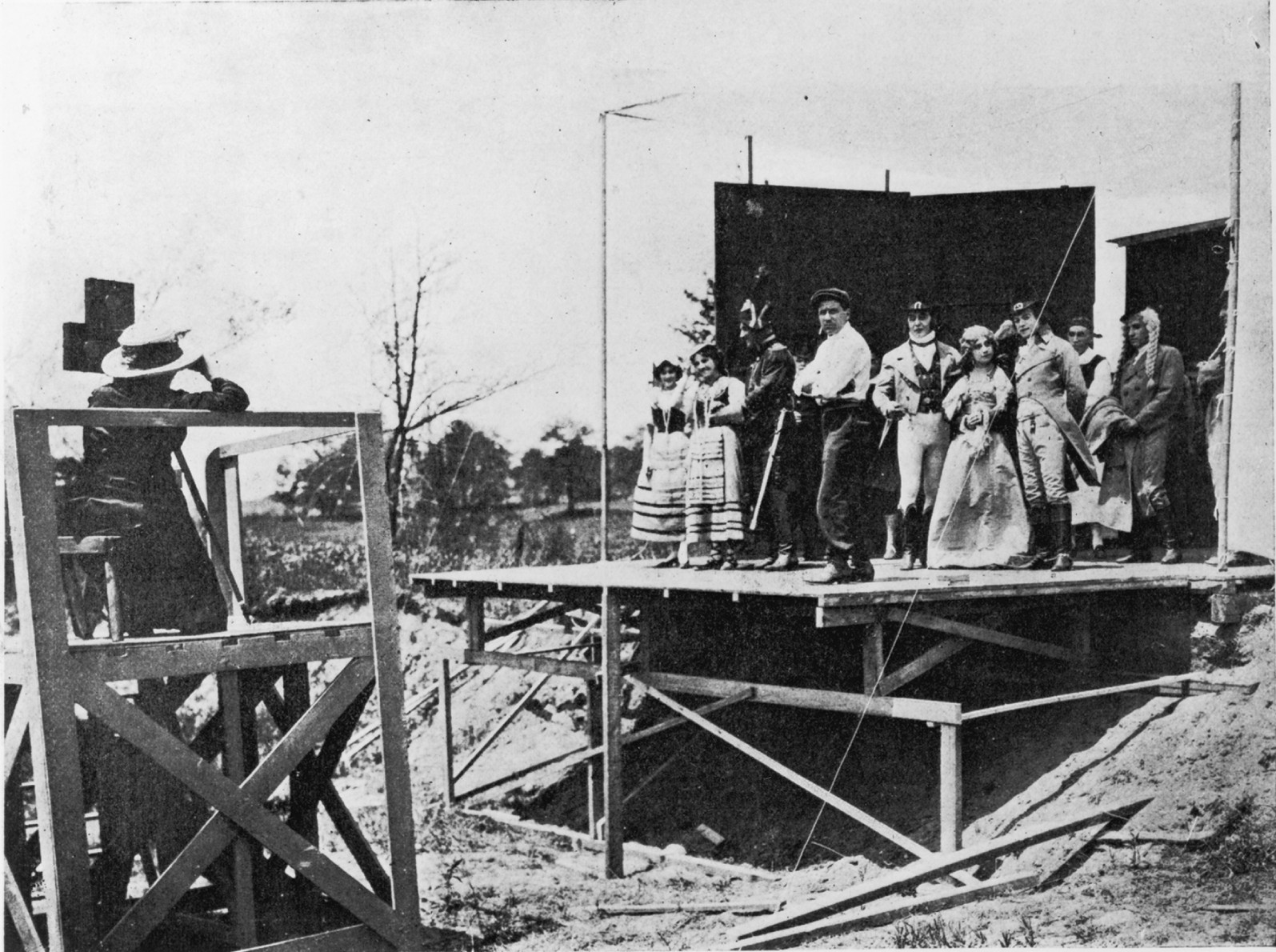
It included a pointed objection to the “overstern, noisy tyrant of the studio.” A director needed patience, she wrote, and a quiet voice could get better results from an actor. That advice is worth keeping beside the photograph of her rehearsing the cast of Fra Diavolo, published in The Moving Picture World in 1915. Guy-Blaché sits on a wooden platform, facing costumed performers on a raised stage. The supports and cross-braces are visible beneath them. All the carpentry of the illusion is there, along with the person responsible for getting the group to work together.
The accompanying article, by Louis Reeves Harrison, describes a visit to Solax in Flushing, New York. He watched her move between jobs during the day: casting, writing, setting scenes and directing actors. He was particularly impressed by her handling of a complicated scene. His praise repeatedly passes through period notions of women’s modesty and manners; he explains that she was reluctant to speak about her achievements, leaving him to obtain parts of her history from others. Even an admiring account had difficulty letting her competence stand on its own.
Guy-Blaché’s “Woman’s Place in Photoplay Production,” published in July 1914, gives her more room to explain herself. She had spent months studying in Gaumont’s laboratory and continued in her own laboratory at Solax. Reading about the work was useful, she said, but taking part in production mattered too. Technical knowledge could be acquired. She had done it and expected other women to be able to do it.
Her account follows the film through decisions that disappear from view once a performance reaches the screen. Someone must choose the exterior location, check costumes and oversee furniture and props. Then there are the actors, with temperaments a director must learn to work with. Her preference for gentler handling belongs to this practical account of preparation. Shouting was a poor substitute for understanding the person being asked to perform.
She also argued through assumptions about women’s natural sensitivity, their knowledge of domestic life and their understanding of love. Those claims limit the essay: they give women permission to direct by assigning them another set of supposedly innate qualities. The laboratory passages offer a more durable argument. They describe time spent learning a skill, without requiring anyone to be born suited to it.
By the time she wrote the essay, Guy-Blaché’s responsibilities extended well beyond her own films. She had married fellow Gaumont employee Herbert Blaché in 1907 and moved with him to the United States, where he was to market the company’s synchronized-sound system, the Chronophone. Their production venture began in Flushing before moving to Fort Lee, New Jersey, then a busy centre of filmmaking close to New York.
Alice was president of Solax; Herbert headed the New Jersey Studio Company, which owned the real estate. The arrangement is easy to flatten into a creative wife and a business-minded husband. In a Library of Congress interview, curator and archivist Kim Tomadjoglou warns against that division. She cites historian Richard Koszarski’s observation that contract law, which treated married women differently in property matters, likely helped shape the companies’ structure. The company titles give only a partial account of her responsibilities.
The enterprise was ambitious, making westerns and military subjects as well as longer productions. In 1913 the Blachés formed Blaché Features to distribute their films. Competition and the rising cost of features brought financial problems; Solax ceased production the following year. Alice continued directing for other companies, but after her marriage ended she returned to France with her children in 1922. She never worked in cinema again.
She left an unusually practical account of the profession that no longer had a place for her. The laboratory hours, the costumes, the actor who needed patience rather than shouting: these were things she knew how to do. In the rehearsal photograph, she still has a scene to finish.

