Liner Notes After Dark / NO. 002
Joy Division’s singer lent records to his bandmates, filled notebooks with lyrics and once talked of opening a shop with his wife. The people around him remembered a life larger than the tragedy that ended it.
By Margin Tone
Ian Curtis was the singer and lyricist of Joy Division, one of the Manchester bands that helped shape post-punk in the late 1970s. They carried punk’s urgency into music with more space and a different balance of instruments: Peter Hook’s melodic bass, Stephen Morris’s insistent drums and Bernard Sumner’s spare guitar, with Curtis’s deep voice at the centre. Producer Martin Hannett made their debut, Unknown Pleasures (1979), markedly more atmospheric than their live performances. That sound, developed further on Closer (1980), became a touchstone for darker alternative rock.
Curtis gave that music words about human beings under pressure. Asked in a February 1980 radio interview whether his lyrics concerned urban decay, he spoke instead about “personal relations and the way people can cope with certain things.” He was interested in individuals and their different responses to problems. Behind those songs was an avid reader, a husband and a young father, trying to fit a growing musical life around everything else. At one point, he imagined giving the band up for books.
He rang Stephen Morris, Joy Division’s drummer, and said he was leaving. He would go to Holland with Deborah, his wife, and open a bookshop.
Morris told him that, if that was what he wanted, he wished him luck. Remembering the call for interviewer Dave Haslam in 2007, he could still describe this other future: Curtis and his wife, together, selling books.
First, though, Curtis had wanted a band.
When Morris first went to Curtis’s house in Barton Street, he’d expected the singer of a punk band to have spiky hair and safety pins. Instead, he found a pleasant married man arranging a rehearsal around the other musicians’ holidays. Morris later borrowed his mother’s Maxi to collect him. They met bassist Peter Hook and guitarist Bernard Sumner, made some noise together, and Morris stayed. He couldn’t remember ever being formally offered the drummer’s job.
Curtis had a day job helping disabled people at Macclesfield’s employment exchange; Sumner worked in animation and Morris worked for his father. Rehearsals had to fit around those hours. Ian and Deborah had married in 1975. She brought scrap paper home from her council job, and he used it for lyrics. Their daughter, Natalie, was born in 1979.
His interests kept entering the band’s life. Hook remembered Curtis lending him and Sumner the Doors’ first album after people compared Joy Division to them. The singer knew the record; the comparison had meant little to the others until then. German experimental music, the Velvet Underground and Iggy Pop joined the hard rock and punk they already knew.
Curtis also visited Manchester’s House on the Borderland bookshop, buying second-hand copies of New Worlds. Publisher Michael Butterworth remembered their friendship beginning through an interest in William Burroughs. He gave Curtis books, and Curtis invited him to gigs. The reserved clerk Butterworth knew became a performer whose movements he found disconcerting, even painful to watch.
In rehearsals, the others would repeat a riff while Curtis searched his lyric book and began to sing. Morris remembered songs arriving quickly, with little discussion afterwards beyond telling him that it was good. The handwritten sheets survive in the John Rylands Library’s Ian Curtis Archive, alongside three small lyric notebooks and his books and records.
The band, renamed from Warsaw to Joy Division, released Unknown Pleasures in 1979. Morris had expected producer Martin Hannett to return a better version of their live sound and was surprised by how different the record was. He liked the drums. Hook and Sumner were less pleased. Even as the songs became recordings, the musicians didn’t all hear the same band.
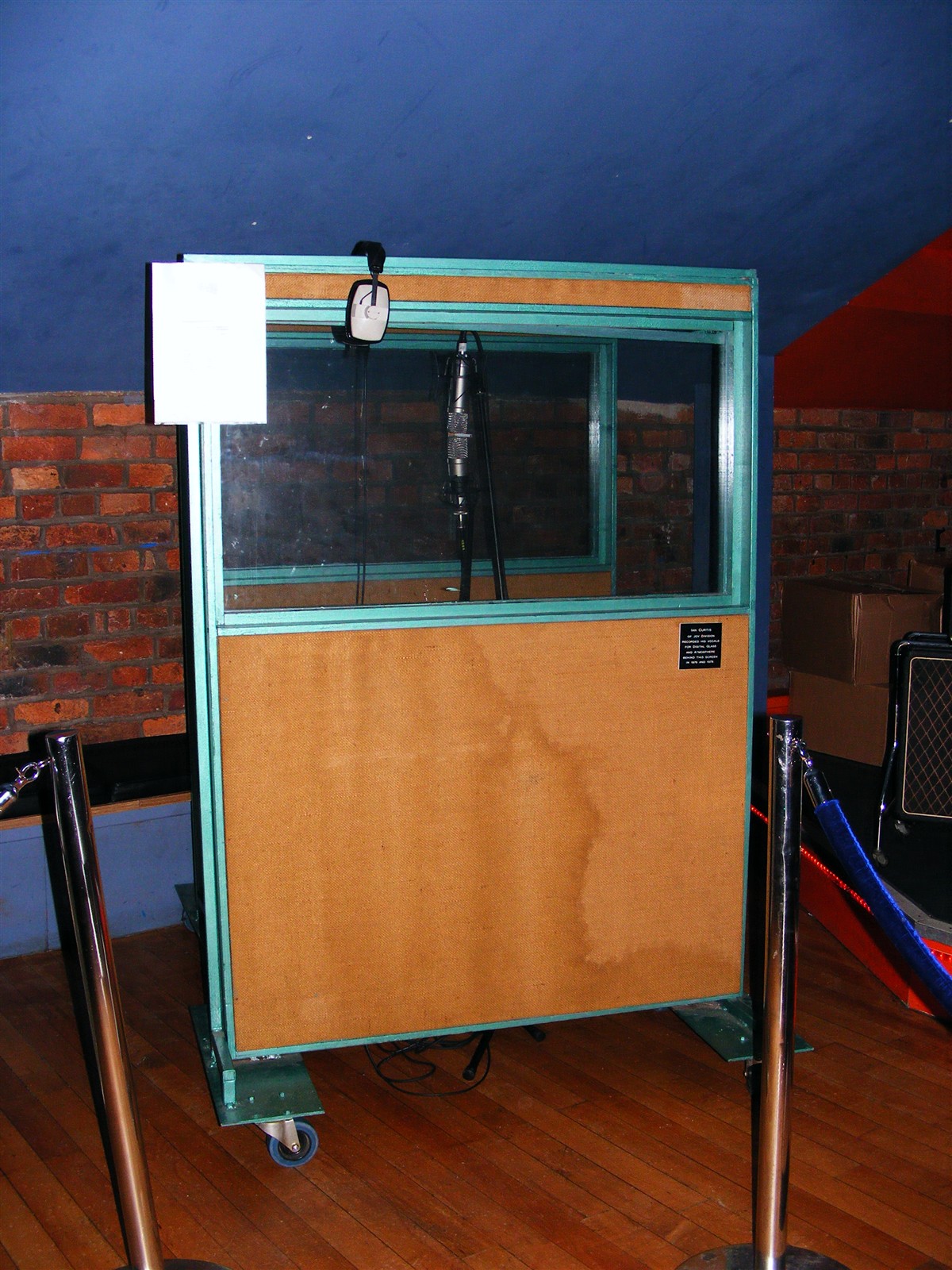
Curtis listened for ideas in what the others played. Hook’s account of “Love Will Tear Us Apart” credits him with spotting a promising bass melody during a jam and asking them to develop it. The result felt unusually light and exposed to the musicians, who preferred songs they could hide behind. Hannett kept revisiting it in the studio, sometimes summoning Hook in the middle of the night. Years later, Hook credited him with a subtlety he and Sumner hadn’t yet learned to value.
In an autumn 1979 interview with the Belgian magazine En Attendant, they described composing together and being equals. Without any one of them, they said, it wouldn’t be Joy Division. There was also the less solemn business of discovering that people wanted to see them. Morris recalled going out for fish and chips near the Nashville in London and wondering what a queue was for. It was for their show. He remembered Curtis laughing most of the time they were together.
Deborah experienced work that the bandmates could leave behind. In Touching from a Distance, she remembered sitting on amplifiers at early shows so they wouldn’t be stolen. There were clothes to wash and iron, cases to pack, employers to make excuses to. Later, after she visited a dressing room, Ian asked her not to come again unless the other girlfriends came too. She understood the women to be becoming unwelcome. Her place beside the band was shrinking as its audience grew.
Curtis had also become close to Annik Honoré, a Belgian music journalist. A 2005 Guardian interview with Deborah described it as an affair. Honoré’s 2010 account to Philippe Cornet described a loving but nonsexual relationship. She remembered first interviewing the band in London, where they stayed with acquaintances because they couldn’t afford a hotel. They were pleased a magazine abroad was interested. As Bowie’s Low played, the others gradually fell asleep, leaving her and Curtis awake.
Honoré helped book the band at Plan K in Brussels and would co-found Les Disques du Crépuscule. She remembered both the force of Curtis’s performances and his exhaustion afterwards. Offstage, he asked questions about the band and his life. At home, Deborah was caring for Natalie.
Epilepsy was making the work dangerous. Sumner later recalled the frightening seizure Curtis suffered in a car after a London show at the Hope & Anchor. He received treatment, but the seizures continued. During the spring 1980 sessions for Closer at Britannia Row, Hook remembered finding him after another seizure in the studio bathroom. Curtis insisted he was all right and didn’t want to go to hospital. They continued recording.
In April, Curtis survived a suicide attempt. The scheduled show at Bury’s Derby Hall went ahead soon afterwards, on 8 April. He could appear for only a couple of songs, with Alan Hempsall of Crispy Ambulance among those standing in. Fighting broke out; Hempsall later called it an ugly club fight rather than the full-scale riot of subsequent retellings.
“Bury should never have gone ahead,” tour manager Terry Mason later said. Lindsay Reade remembered Curtis telling her there that he could see the band continuing without him; she understood him to mean that he couldn’t keep performing. Afterwards he stayed with Reade and her then-husband, Factory Records co-founder Tony Wilson, in Derbyshire, away from the shows.
An American tour was approaching. Before the band could leave, on 18 May 1980, Ian Curtis died by suicide. He was twenty-three.
Those close to him have spent years trying to understand his death. His depression and epilepsy, the strain of performing and the difficulties in his marriage don’t add up to a single explanation. Asked in 2005 why he hadn’t simply left the marriage, Deborah said: “I don’t know. I’ve spent a lot of time wondering, because there were so many other things he could’ve done besides commit suicide.”
“Love Will Tear Us Apart” came out that June, and Closer followed in July. Hearing the album for the first time shocked Deborah. Yet she resisted turning even “Love Will Tear Us Apart” into a straightforward account of their marriage. The handwritten drafts tried variations: “your bedroom”, “this bedroom” and “the bedroom.” “I don’t know how much is fiction and how much is reality,” she said in a 2014 interview.
The surviving musicians formed New Order. Deborah, Natalie, his family, Honoré and his friends lived on with different memories of him. Among them is Morris’s telephone call: Curtis saying he and Deborah would move to Holland and open a bookshop, and the drummer wishing him luck if that was what he wanted.


