Godflesh’s penultimate album finds something gripping in the grind, even when its longer songs ask a little too much of your patience.
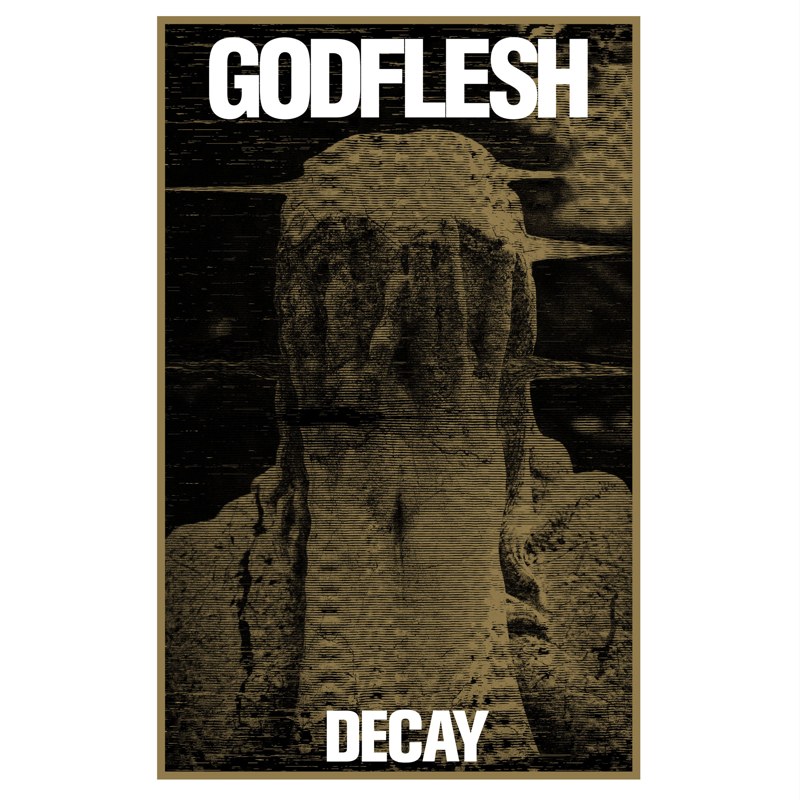
There is a strange comfort in knowing where the next heavy beat will land. Godflesh give you that much on Decay. The drums hit, the low notes grind, and the pattern comes around again. What they do not give you is much relief. Thin, piercing sounds hang above the weight below, making a rhythm you could nod along to feel anything but welcoming.
That push and pull is the album’s appeal. You do not need to know Godflesh’s history, or the finer points of industrial metal, to understand it. There is something satisfying about music this firm and physical. There is also a point where satisfying becomes tiring. Decay spends a lot of time near that line.
Released September 25, 2026, it is Justin Broadrick and bassist Ben Green’s tenth album, with one more planned before Godflesh ends. Its songs grew out of the same recording sessions as 2023’s Purge, then underwent further changes. This is not a farewell assembled from scratch, and it is better judged as a record than treated as an occasion to applaud the band for lasting this long.
Something to hold on to
“Master and Slave” takes nearly nine minutes to open proceedings. Its repeated low blows and ringing upper sounds offer a good way into the album: follow the beat, then notice what refuses to fade neatly between the hits. The rhythm gives the noise a shape. The noise makes that shape uncomfortable to sit inside.
There is more at stake here than anger. Broadrick describes Godflesh as an expression of pain—mental, philosophical and existential. In his recent Guitar World interview, he traces the band’s terrifying sound back to being frightened himself. That background offers a useful way into Decay: its force can be heard as a response to feeling powerless, rather than a celebration of having power.
Even the titles place control and vulnerability close together. “Master and Slave” names a relationship built on domination; “Fear Of Man” turns other people into a source of threat; “Fodder” suggests a life reduced to something expendable. Read together, they point toward alienation in a very ordinary sense: feeling used, mistrusting the people around you, and struggling to keep a sense of yourself. This is a reading of the record’s language and atmosphere, not a claim that each song tells a literal story.
The repetition gives that reading its weight. A pattern that keeps returning can suggest a situation you cannot change, or a thought you cannot stop having. The music’s physical pull complicates things: it can offer an outlet for those feelings while keeping you inside them. That is what makes the heaviness more unsettling than a straightforward release of anger.
“Living/Ending” makes a more compact case. Its riff and percussion have a directness that gives newcomers something solid to grab. It would be the sensible place to start if you are curious but not ready to commit to the whole record. The attraction is the force of the repeating pattern, not a promise that a sweeter chorus will eventually make everything all right.
“Feral Colony” and “Fear Of Man” sit alongside it in the shorter middle stretch, before “Fodder” leads into the enormous closer. These four songs run roughly five or six minutes each. Compared with the tracks surrounding them, that counts as restraint.
“Fodder” helps explain why fewer drum hits do not necessarily make this music feel lighter. Distorted sounds linger in the gaps, filling the space before the next impact. The beat may leave room, but the rest of the music takes it up. That crowded feeling matters more than sheer speed: heaviness can come from having nowhere for a sound to go.
How much is enough?
The closing “Consume Me” lasts almost twelve minutes. Its title makes the struggle over control more intimate: being consumed might mean being destroyed, but it can also suggest surrender, the wish to stop resisting. That ambiguity is more interesting than a simple declaration that everything is hopeless. It leaves room for exhaustion as well as defiance.
Together, “Consume Me” and “Master and Slave” take up nearly half of the album’s approximately 42 minutes. Broadrick has called them its most important pieces. Their titles frame the record with domination at one end and the possibility of surrender at the other; their length makes that tension difficult to shrug off.
There is a strong case for that approach. Once a pattern becomes familiar, smaller things can start to matter—the rough edge of a note, the sound left hanging after a strike. What initially seems repetitive can become absorbing.
But it does not always follow that more time means more depth. The long tracks are the biggest reservation here. Their scale gives the album weight, while also making it harder to escape the same mood. If the shorter songs give you enough of what you came for, the extra stretch may feel like a demand rather than a reward. You do not have to enjoy every minute to appreciate what Godflesh are trying to do.
Broadrick’s health gives the approaching end of the band a sad context. He has spoken about abdominal surgery and the physical cost of Godflesh’s shouting. Importantly, the vocals were recorded before the operation; the album was mixed afterward. Those circumstances deserve care, but they should not make the music immune to criticism.
Decay is worth trying because its heaviness gives fear, powerlessness and exhaustion a physical shape. Its rhythms offer something to hold on to without pretending those feelings have been resolved. That stubbornness is both a strength and a limitation. Start with “Living/Ending.” If that combination of grip and discomfort appeals, the longer journey may be worth it. Just do not mistake finding it exhausting for failing to understand it.
About this review: Written from release research and published criticism, with supplementary Gemini 3.8 Flash audio checks—not a claim of independently verified full-album listening. Sources: Guitar World interview, Relapse, The Quietus, PopMatters, Echoes and Dust and Distorted Sound.

