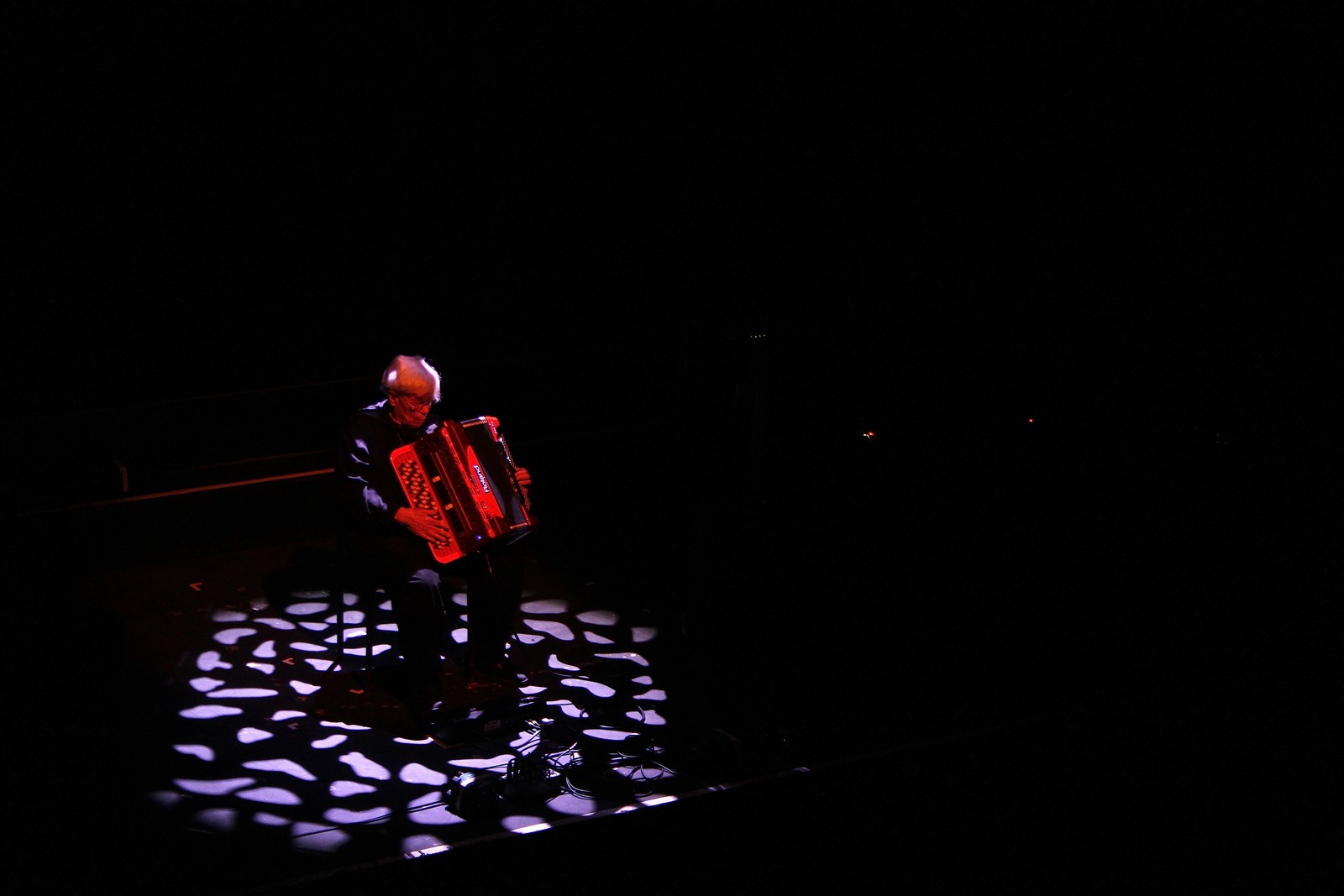
Pauline Oliveros’ underground recording supplies an unforgettable image. The practice surrounding it asks for something less spectacular and more demanding: sustained attention.
A room can keep sounding after its occupants have stopped. In the Fort Worden cistern in Port Townsend, Washington, that persistence was extraordinary: a 2012 press release preserved on Pauline Oliveros’ website describes reverberation lasting 45 seconds at low frequencies. The qualification matters. This was not a uniform stopwatch attached to every note, but a particular acoustic environment with an unusually long memory.
In 1988, Oliveros, Stuart Dempster and Panaiotis entered the underground space with audio engineer Albert Swanson. Their work became Deep Listening, released by New Albion in 1989. The same primary account describes a reinforced-concrete cylinder, 186 feet in diameter and built to hold two million gallons of water. Music made inside former infrastructure is a compelling image. It can also become so compelling that it obscures the longer work around it.
Deep Listening is not simply the name of a recording technique, nor a recommendation to find a room with impressive reverb. The Center for Deep Listening at Rensselaer describes the practice through the difference between involuntary hearing and conscious listening. Its materials include bodywork, sonic meditations and interactive performance, as well as attention to daily life, nature, thoughts, imagination and dreams. The concert is only one possible setting.
Before the descent
The chronology itself discourages an origin myth confined to the cistern. Rensselaer identifies Sonic Meditations, published in 1971, as early published scores and activities associated with the practice. These were developed over months with the fem-ensemble, a female-identified collective. From the 1980s onward, workshops, retreats and the certification programme were developed in close partnership with playwright IONE and movement artist Heloise Gold. The institutional account names collaboration as a working method, not a courtesy appended to an individual genius.
That emphasis changes the apparent scale of the enterprise. A recording preserves a performance; a practice has to be repeatable by people who were not present. Scores, exercises, workshops and discussion provide ways for attention to be tested, described and shared. In a 1999 text excerpted by the Center, Oliveros calls Deep Listening “a life long practice” and says previous musical training is not required. Neither statement makes it effortless. Together, they detach entry from credentials while refusing the idea of a quick completion.
Her description also keeps focus and openness in play at once. Listening can take in a broad field, then narrow toward something of particular importance. The inclusion of remembered and imagined sound makes the field larger than whatever a microphone would capture. It is a useful corrective to treating attention as merely turning up the resolution on a familiar object. The listener’s habits belong to the exercise too.
Taking the room elsewhere
The cistern story has its own practical sequel. The 2012 release announced plans for concerts using software developed by Jonas Braasch and his team to simulate its acoustics. The proposed system used 32 loudspeakers, with microphones capturing both performers and audience sounds for processing. The intention was not simply to play an underground recording through a concert-hall system, but to let new activity enter a model of that resonant space.
There was a physical reason for the translation. Access to the actual cistern was through a small manhole, and a sizeable audience would absorb sound and change the very reverberation people had come to experience. Making the space more accessible meant acknowledging that visitors would alter it. The announcement is revealing as a design proposal: participation is not acoustically neutral, and an audience is not separate from the environment it hears.
At Rensselaer, the Center established in June 2014 carries the work through courses, intensives, certification, workshops and retreats, while housing the Deep Listening Institute’s archives. Preservation and continued practice sit together. The archive keeps a history available; the teaching creates occasions on which listening can happen differently.
The cistern remains an excellent doorway into this history. It makes duration tangible and gives attention a memorable address. But the larger invitation does not depend on going underground or owning a particular record. It lies in a discipline that can pass between people: noticing what is already sounding, recognizing how one attends to it, and leaving room for that attention to change.


