A.G. Syjuco’s five-track EP finds dread in familiar voices, broken melodies and old toys—and tenderness in the difficult business of letting go.
A man and a woman trade lines in “Nothing Ever Grows Here” with a composure the instruments refuse to share. The bass growls through heavy distortion; guitar feedback screams between stanzas. Against that abrasive sound, his dry phrases and her softer answers feel unnervingly measured. They describe a place without visitors, passing hours or crying children, as though explaining an arrangement they have learned to accept. The rhythm gives their exchange a reassuring order, but the noise makes that reassurance difficult to trust. By the time “Stay with me” arrives, comfort and confinement are using the same words.
That ambiguity gives Black Leather Birds’ of Children and Their Sorceries its force. Across five tracks and just over seventeen minutes, A.G. Syjuco takes the things that make a home familiar—voices, rituals, objects—and makes them difficult to trust. A story settles into a bass-heavy beat. An electric-piano tune sounds damaged. The small mechanisms of old toys become the materials of a farewell. The record can be tender, grotesque and faintly ridiculous within the same passage, but its affection is more than a setup for the next fright. By the end, holding on has become as painful as letting go.
Released in May 2026, this is the second EP from Syjuco’s solo project, alongside his work as composer and producer in Jack of None. The distinction matters less as a résumé entry than as a change in responsibility. In a ROMBO interview, he described moving from building music around words by his sister Maxine or his father to writing these pieces himself. He also connected the record to his family buying a house. The resulting language is full of ordinary household particulars: a screen door, a coffee mug, a table, a bedtime instruction. There’s enough furniture here to make the stranger ideas feel lived in.
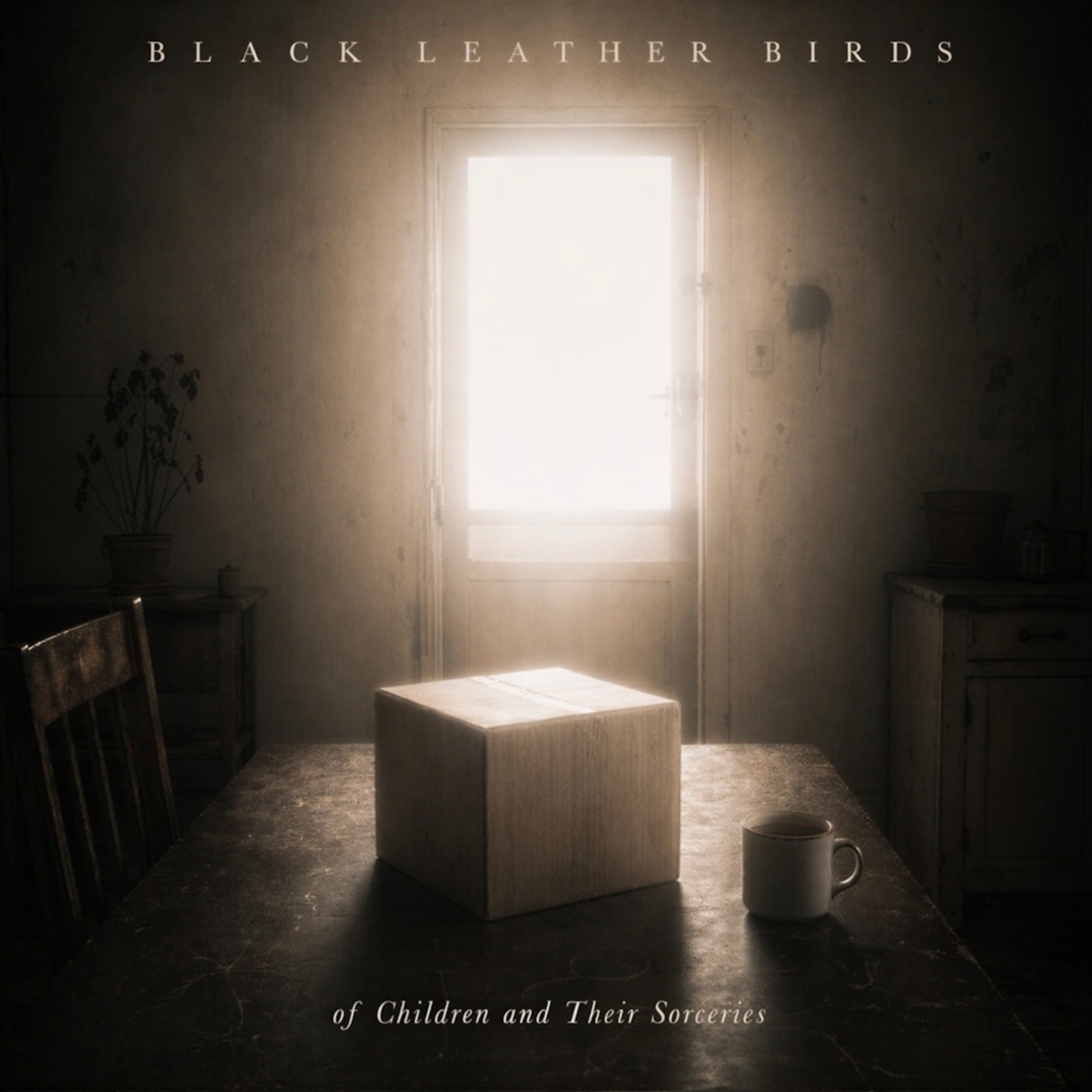
The artwork makes a useful introduction. On the cover, a sealed cardboard box occupies a worn table beside a mug; daylight blows out the doorway behind it. On the back, the view retreats outside, looking through a weathered screen door toward the box. Neither image supplies a monster. They make the act of looking into a house feel questionable. The music achieves something similar by keeping its voices near while leaving the spaces around them uncertain.
A promise with no exit
“Nothing Ever Grows Here” is an excellent opening because it establishes the record’s central problem without explaining it away. Its measured exchanges could describe perfect safety or complete extinction. No crying children sounds reassuring until the surrounding lines remove movement, visitors and time itself. The recurring rhythm is essential: the account of a motionless world arrives on music that continues to pulse. These people aren’t outside time so much as caught repeating it.
The distortion matters as much as the duet. The growling bass gives the repeating pulse a rough, grinding weight, while the feedback makes the gaps between stanzas feel anything but empty. It is an unnerving answer to words about a place where nothing stirs. The singers hold to their turns; the instruments seem less capable of containing themselves. That contrast lets the song pull in two directions at once: there is pleasure in the rhythm and the measured exchange, and unease in the sound surrounding them. Their composure might feel consoling, or it might make the noise more disturbing. Neither response requires the listener to feel as resigned as the voices sound.
Syjuco’s account of the song adds a more painful dimension. In the same interview, he recalled wishing he could stop time while lying beside Wenli, the family cat, during a prolonged illness. He explicitly connected that wish to the opener. Read that way, the absence of change is a bargain made out of love: nothing can die if nothing is allowed to grow. The song works because it preserves the cost of the bargain. Its affection doesn’t cancel its horror.
He also said he recognized the resemblance between the alternating voices and his family’s weekly rosary only later, while mixing. That retrospective connection illuminates the performance without turning it into a coded religious argument. Call and response can hold people together; it can also make a proposition feel settled before anyone has examined it. Here, devotion and submission use much the same cadence.
“Monster” breaks that composure in barely more than a minute. Its opening voice drags through four lines that knot care and harm together: an apron, a noose, a tourniquet. The long, altered tones make the words feel heavy. Then the music abruptly shrugs off that weight and becomes something much more skittish.
A twisted electric-piano melody picks its way across a raw drum beat. It sounds broken without becoming shapeless: there is still a tune to catch, but its unstable little movements deny it any reassuring sweetness. Alongside it, a woman’s scat splutters into guttural noises and breaths. The beat gives those sounds somewhere to land; it does nothing to make them seem well behaved. This is the track’s nastiest turn. What began at a forbidding distance is suddenly uncomfortably close.
The ending lasts only long enough to establish that new discomfort before cutting it off. Its brevity works as a jolt, not a sketch waiting for a proper chorus. The shift from drawn-out invocation to this twitchy, damaged music does the developing. Between the opener’s ritual and the next track’s patient storytelling, “Monster” is a short loss of composure that neither of them can provide.
Delivery instructions
“The Box” is the center of the EP, both in sequence and in imaginative reach. It tells the story of Gerald Mund, who receives an unsolicited parcel that becomes increasingly foul, apparently alive and impossible to open. Syjuco gives the narrator an easy, conversational delivery over a patient, bass-heavy beat. The gruesome details accumulate while the accompaniment remains comparatively composed. The song understands that horror can become funnier—and less escapable—when the music declines to panic.
The discrepancy between a UPS label and FedEx tape is a particularly good detail. It begins as the sort of petty logistical inconsistency someone might genuinely notice, then acquires the importance of a supernatural warning. Gerald’s father, his unpaid bills and the plastic plant on his table gradually make the story about more than a threatening delivery. The parcel becomes one more thing he cannot account for but must live beside.
There is an affinity here with Laurie Anderson’s use of conversational narration against electronic accompaniment: the casual voice makes an impossible situation sound briefly administratively plausible. But Syjuco’s story is more crowded and physically unpleasant. Rot, buzzing and wounded fingers push against the groove’s composure. Crucially, the sounds described by the narrator needn’t all become literal sound effects. The language does much of the dirty work; a beat that over-illustrated every event would reduce the tension to a demonstration.
The prose occasionally works too hard. Its succession of comparisons can make the narrator seem determined to certify the significance of each new sensation. The plain domestic details are often stronger than the explicit declarations of cosmic wrongness. Yet the ending justifies the leisurely telling. Gerald doesn’t defeat the thing or discover what is inside. He brings it inside, and the final admission arrives with the exhausted matter-of-factness of someone describing a new appliance. The joke is also a small defeat.
Syjuco has spoken about later recognizing a connection between that act and bringing Wenli’s ashes home; he was clear that he had not consciously written the story about that experience. The distinction is worth keeping. The track doesn’t require a biographical key, and its emotional possibilities would shrink if the box could be translated into a single correct answer. What matters is the change in Gerald’s conduct: resistance gives way to accommodation, without making the object any less disturbing.
When the instructions stop
“Almost” brings the pressure back into the voice itself. Spacious singing delivers the bedtime language, then yields to a rapid stream of instructions. “Say the number, do as told” exposes the discipline inside the soothing routine. The rush of syllables becomes an attraction of its own, a refrain you can follow rhythmically before catching every implication. The slower melodic phrases and brisk recitation keep making each other sound less innocent.
Tricky’s Maxinquaye offers a useful point of orientation for this friction between vocal registers and electronic rhythm, rather than a claim of direct influence. As on that record, intimacy needn’t produce a unified or trustworthy speaker. But “Almost” organizes the contrast around a conspicuous interruption. About a third of the way through, the percussion falls away into soft, piano-like tones, and a low spoken voice begins considering whether it is really present. After all the commands, uncertainty feels like progress.
This is one of the EP’s most affecting stretches. The image of learning the location of a wound gives the reflection something concrete to hold onto. Whispered responses make the confession feel less private, but the pauses still have room to register. There is no dutiful swell beneath the important words. When the beat and quick refrain return, their familiarity has acquired a cost. They also lose a little of their surprise. The crowded words can obscure images worth lingering over, especially after the middle has demonstrated how much a plain phrase can do.
“Goodnight My Darling” makes its lullaby out of old toys. Springs, wind-ups and little percussive mechanisms click, rattle and ring, their small sounds busy with movement. There is something touching about that scale after the preceding songs’ elaborate language. The tune offers a recognizable sweetness, but it cannot keep the toys behaving themselves.
The music takes sudden turns. A bright children’s lullaby slips into a darker version of itself; the toy sounds seem to break and screech, turning play into something briefly alarming. Syjuco describes these as moves from the major into its relative minor. The effect is less like entering a different world than finding something wrong with the familiar one. The sweetness remains close enough to remember, which makes each sour turn more disquieting. This is where the record’s sound does what its words sometimes explain too insistently.
The piece is a homage to Wenli, the beloved cat Syjuco calls his baby boy. That dedication gives the toy sounds a tenderness their strangeness cannot exhaust. It also changes the meaning of the lullaby: this is care directed toward someone who can no longer be tucked in. The broken and screeching passages needn’t turn that love into a horror device. They let distress interrupt it.
At the end, the busy mechanisms fall away and a drone remains. After all those little attacks and repeated motions, the sustained sound feels startlingly unoccupied. Syjuco’s image for it is a soul being released. The music leaves room for that reading without forcing a triumphant resolution: the drone lingers, and the farewell has time to register. Where the opener imagined stopping the clocks, the closer finally allows the motion to cease.
of Children and Their Sorceries is strongest when it lets a sound complicate an apparently simple feeling. The opener’s duet makes captivity companionable; “Monster” finds something frightening inside a lively beat; the closer makes toys carry grief without asking them to speak. The writing can still overstate its effects, particularly in “The Box,” and “Almost” is more revealing in its hesitant middle than in another rush through its refrain. But those reservations belong to a record with a distinct sense of how affection can become entangled with fear. Its final movement is the crucial one. The need behind “Stay with me” survives, even as the music finds a way to say goodnight.
Black Leather Birds — of Children and Their Sorceries · EP · May 2026 · Five tracks, approximately 17 minutes.
Listen / download on Bandcamp · Artist website
Artist background and release details: Black Leather Birds’ official website. Public interview context: ROMBO Magazine’s conversation with A.G. Syjuco. Sound-source details, harmonic description and the dedication of “Goodnight My Darling”: A.G. Syjuco. Lyric quotations checked against the supplied lyric booklet and recording metadata. Cover artwork supplied with the release.

